Join our Email List
Series
Volume 9
Anthropology's Ancestors
See Related
Anthropology JournalsEmail Newsletters
Sign up for our email newsletters to get customized updates on new Berghahn publications.
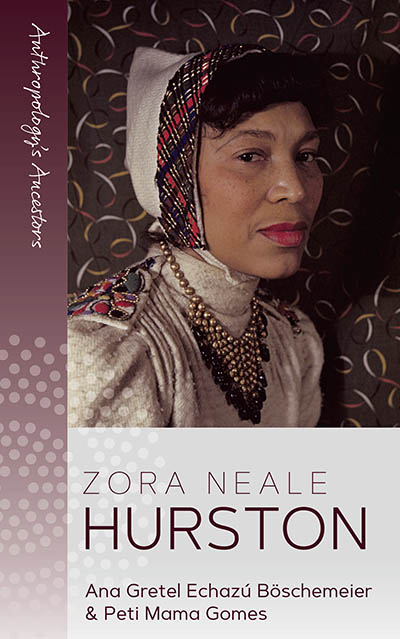
Zora Neale Hurston
Ana Gretel Echazú Böschemeier and Peti Mama Gomes
Foreword by Kimberley D. McKinson
110 pages, 13 ills., pages, bibliog., index
ISBN 978-1-83695-348-7 $120.00/£92.00 / Hb / Published (June 2026)
ISBN 978-1-83695-351-7 $19.95/£15.95 / Pb / Published (June 2026)
eISBN 978-1-83695-349-4 eBook
Reviews
“This book offers an insightful and innovative approach to Hurston’s oeuvre. By applying a transatlantic and decolonial reflexivity, it sheds new light on Hurston’s work through a Black feminist lens from the Global South.” • Gabriel Chagas, University of Miami
Description
Exploring Zora Neale Hurston’s life and work through a decolonial lens, this book traces Hurston’s journey from her early life (1891–1919) and struggles at the margins (1920–1930) to her peak as a pioneering ethnographer and writer (1931–1956) and her later years (1957–1960). Examining her navigation of a hostile academic environment, it highlights her redefinition of Black autonomy and diasporic identity. Through personal and political narratives, including Barracoon, it underscores Hurston’s enduring influence on Anthropology and contemporary Black thought.
Ana Gretel Echazú Böschemeier is a tenured researcher at Fiocruz Brasília and an active member of the IUAES Commission on Human Rights, as well as a part of the leadership board of the ITD Alliance. She is a former tenured professor at the Federal University of Rio Grande do Norte (UFRN) and a former scientific assistant at the Brazilian Ministry of Racial Equality (MIR). She was awarded the TWAS-UNESCO Fellowship (2022–2025) and was a visiting professor at the Gender and Development Department at the Asian Institute of Technology and Thammasat University (both in Thailand). She is the leader of the “Best Practices for Epistemic Justice” of the Brazilian National Council (CNPq) and serves as a Global Youth for Peace Fellow (2025–present), working with youth displaced by the climate crisis. Her work bridges anthropology, decoloniality, human rights, and intercultural knowledge production. She has written, translated, and published numerous essays, scientific articles, book chapters and books in English, Spanish, Tupi Nheengatu, Finnish, and Portuguese.
Peti Mama Gomes holds a PhD in Social Anthropology from the Universidade Federal do Pará (UFPA). She is currently a tenured professor at Universidade da Integração Internacional da Lusofonia Afro-Brasileira (UNILAB–Ceará), where she teaches in the Bachelor’s Degree in Humanities program. Her research focuses on Political Anthropology, gender, corporealities, community health, care, and African and African diaspora studies, with particular attention to Guinea-Bissau and the experiences of African students in Brazil. Working in multiethnic and plurilingual contexts (Kriol, Mandjaku, and Wolof), she collaborates with women’s organizations in Guinea-Bissau on community health practices and local agroecological production. She is a member of the DGP/CNPQ Coletivo Boas Práticas Research Group and has participated in international initiatives focused on anti-racist education, epistemic justice, and affirmative action policies in Latin America, including the UNESCO/UNTREF project “Translating the Global South(s)” (2021).
Subject: Anthropology (General)
Area: North America
Contents
Of Related Interest
It Happens Among People
Resonances and Extensions of the Work of Fredrik Barth
Self in the World
Connecting Life's Extremes
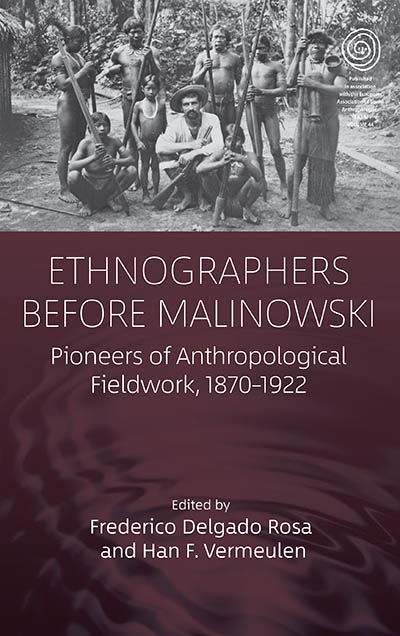
Ethnographers Before Malinowski
Pioneers of Anthropological Fieldwork, 1870-1922